Resume Builder
Your resume is like an introduction to employers. It tells them who you are, what you know, what you can do, and how to contact you. Unlike a job application, which only asks for specific information, your resume lets you explain why you'd be a great hire. Our easy-to-use tool guides you through each step of building a professional resume that showcases your skills, experiences, and achievements. Whether you're entering the workforce or looking to advance your career, we will help you present your best self to employers with confidence.
Step-by-Step Guide
Step-by-Step Guide
A successful resume should include a personal summary, your education history, work experience, and professional skills. Read through the tabs below to learn more about each resume section and view examples of what information should be included.
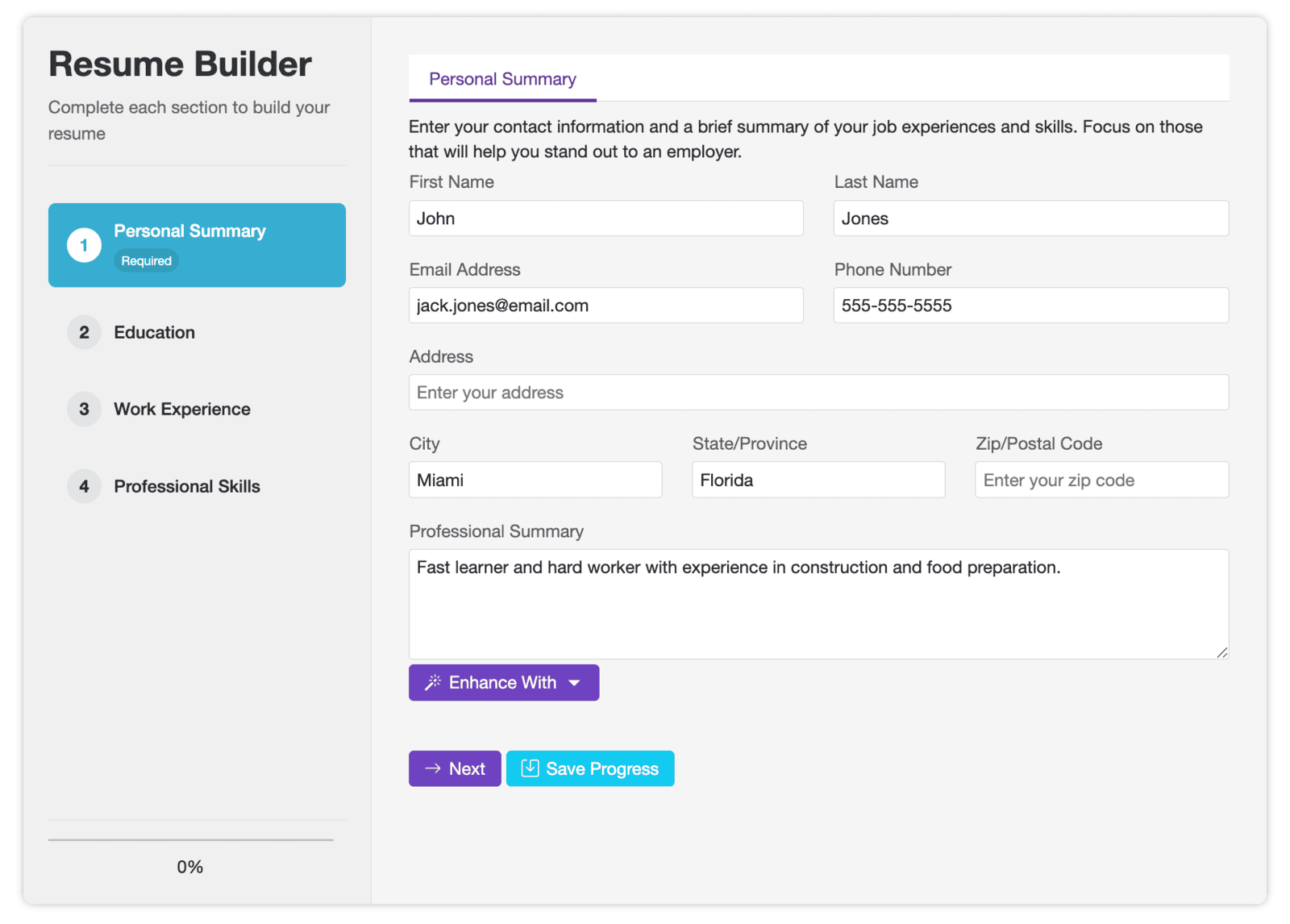
Start by adding these basic details about yourself:
- Name – You can include a nickname if you like. For example: John (Jack) Jones.
- Address – It's okay to only list your city and state since most employers will email you. For example: Miami, Florida.
- Phone Number – Make sure your voicemail for the phone number you list is active and appropriate.
- Email Address – Use a professional-sounding email address that you set up just for job searching.
Next add a simple professional summary. Your summary should quickly answer the question:
Why should someone hire you?
Choose two or three of the following elements to include in your professional summary:
- Specific job skills and any related experience
- Familiarity with tools or software for the job
- Key soft skills (like teamwork, critical thinking, or communication)
- Any awards or recognition you've received
- Achievements that relate to the job, such as recent graduation or certifications
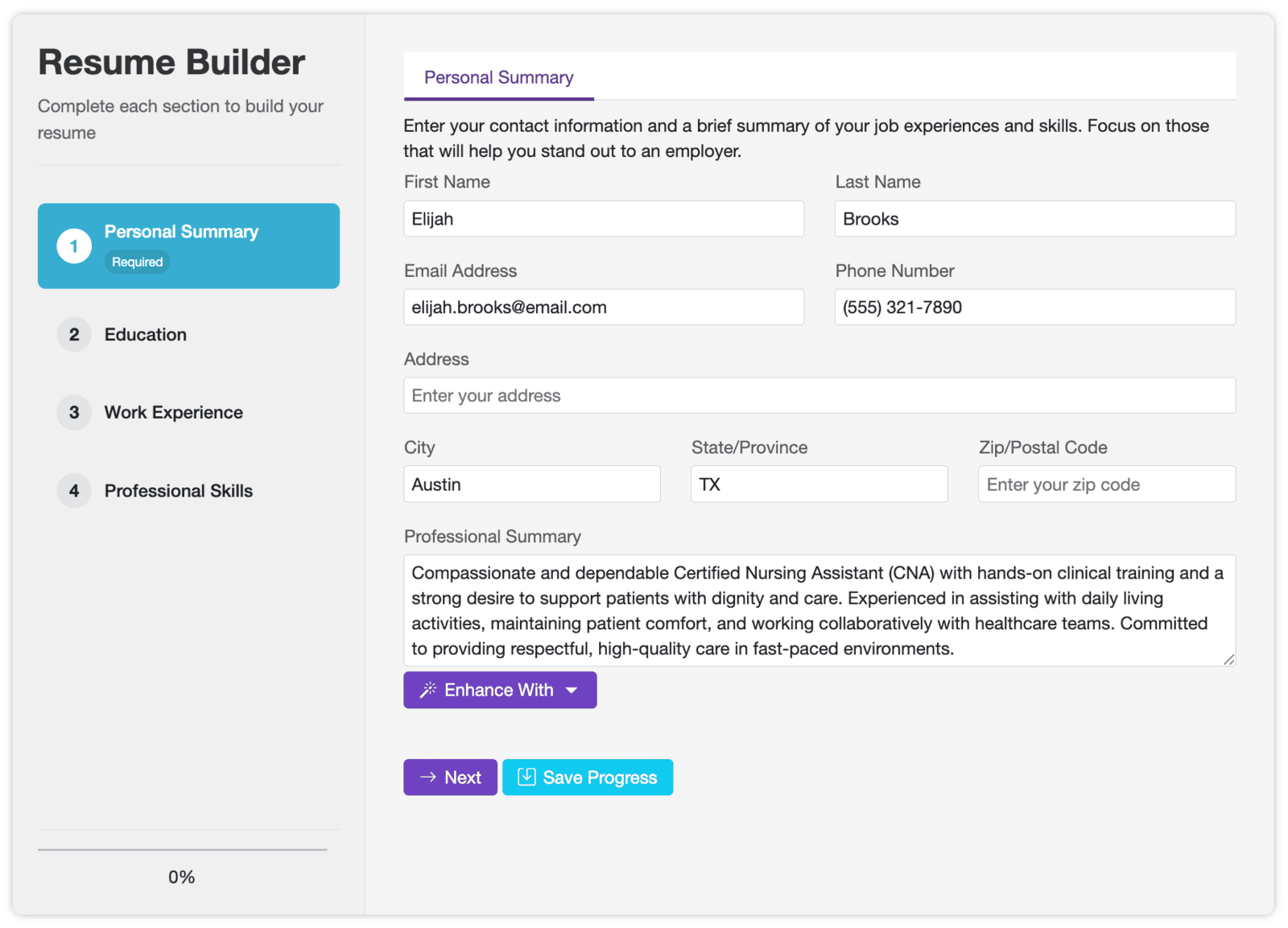
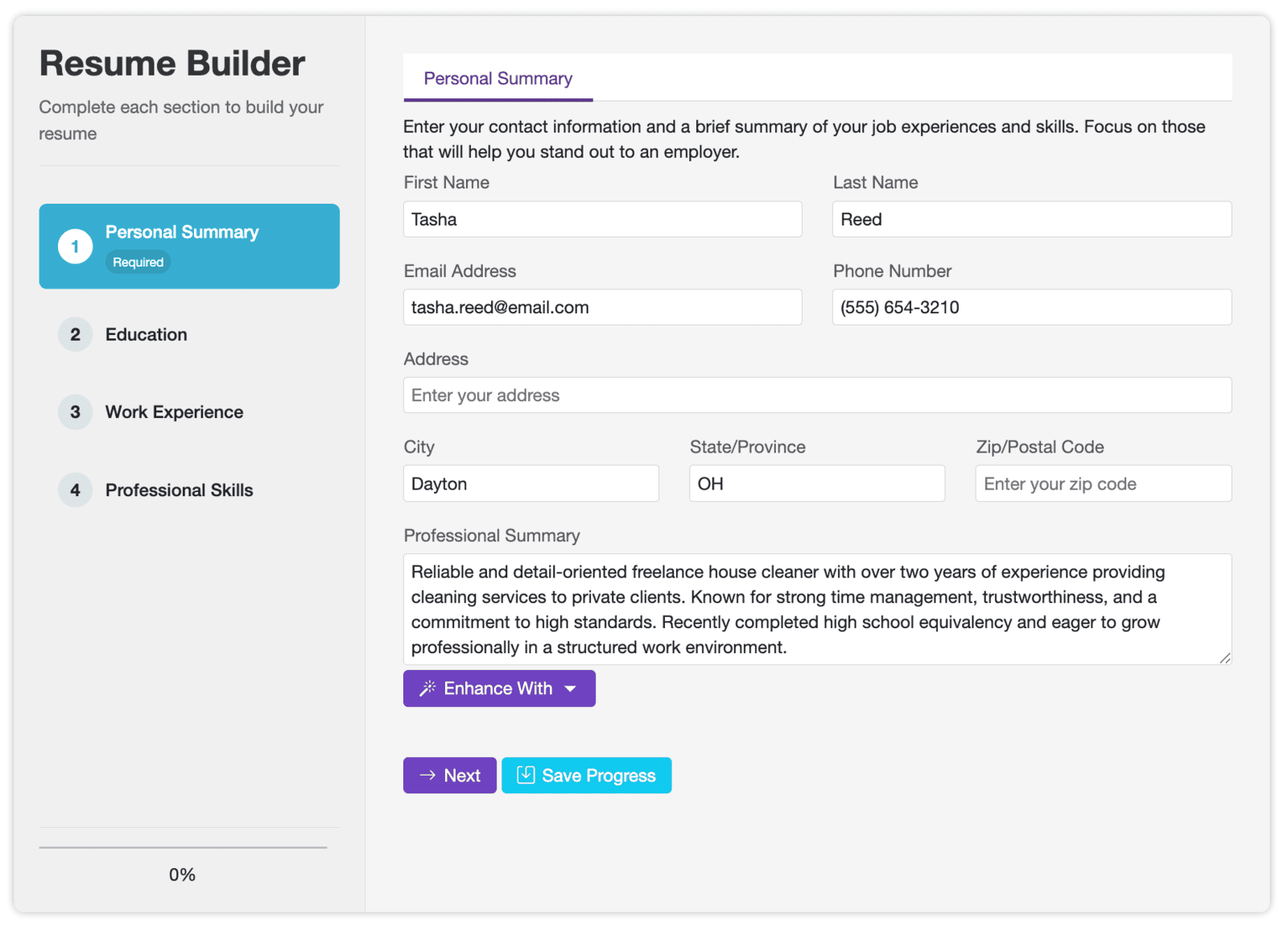
Here’s an example:
Motivated self-starter with food safety training and three years of experience in restaurant service. Bilingual in English and Spanish with skills in working with a team, handling payments, and providing customer service.
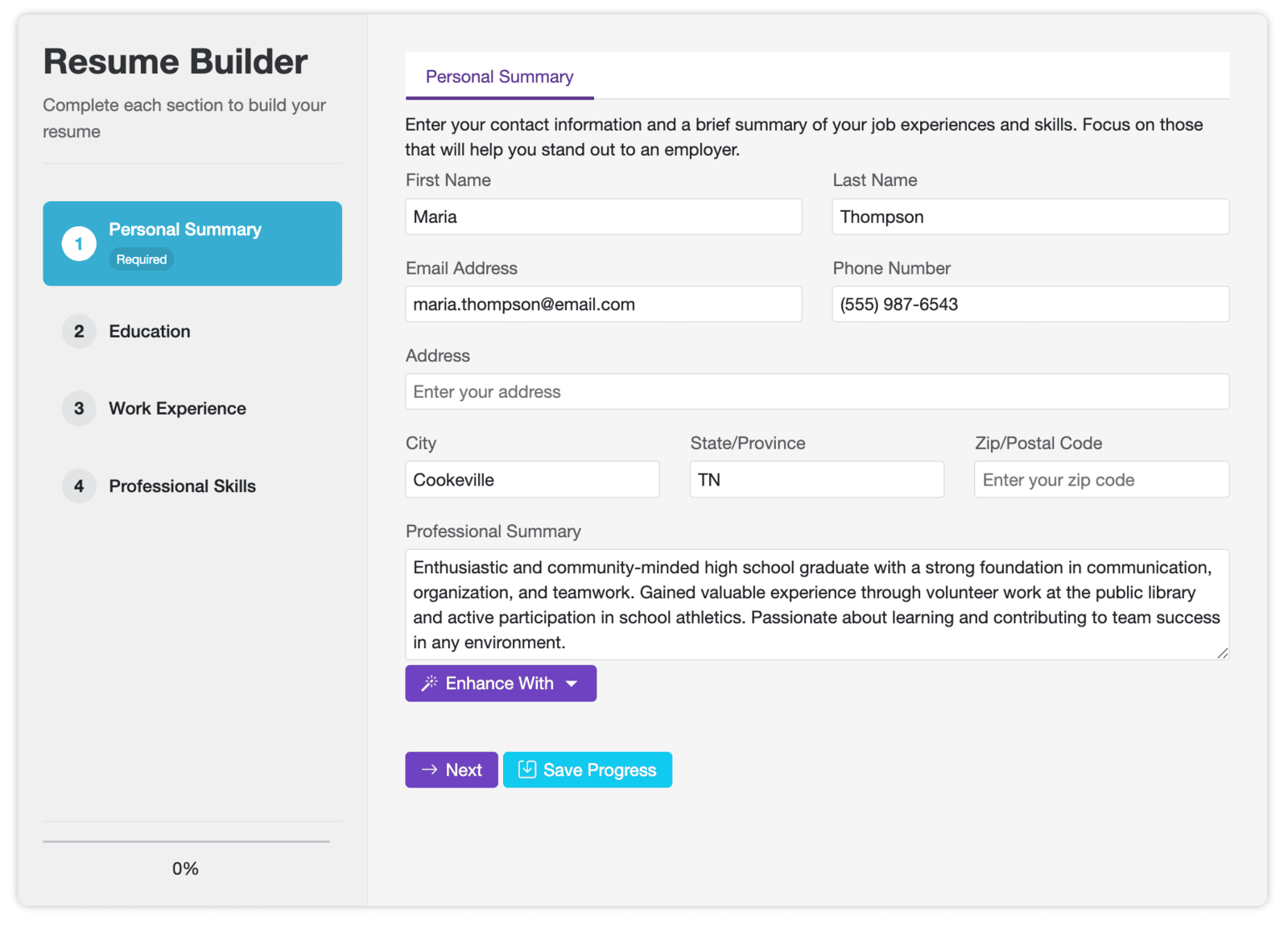
If you don’t have any job experience yet, highlight your job-related experience like volunteering or helping solve problems with a team. Here’s an example of how a professional summary sounds for someone who is entering the workforce for the first time:
Enthusiastic volunteer with experience at the local library and strong organizational skills. Team player skilled in time management and adapting to new challenges as well as working with digital documents and spreadsheets.
Don’t worry if your professional summary doesn’t sound as impressive as our examples yet. That’s why we designed the Enhance with AI tool to help reword and improve elements of your resume as you build it!
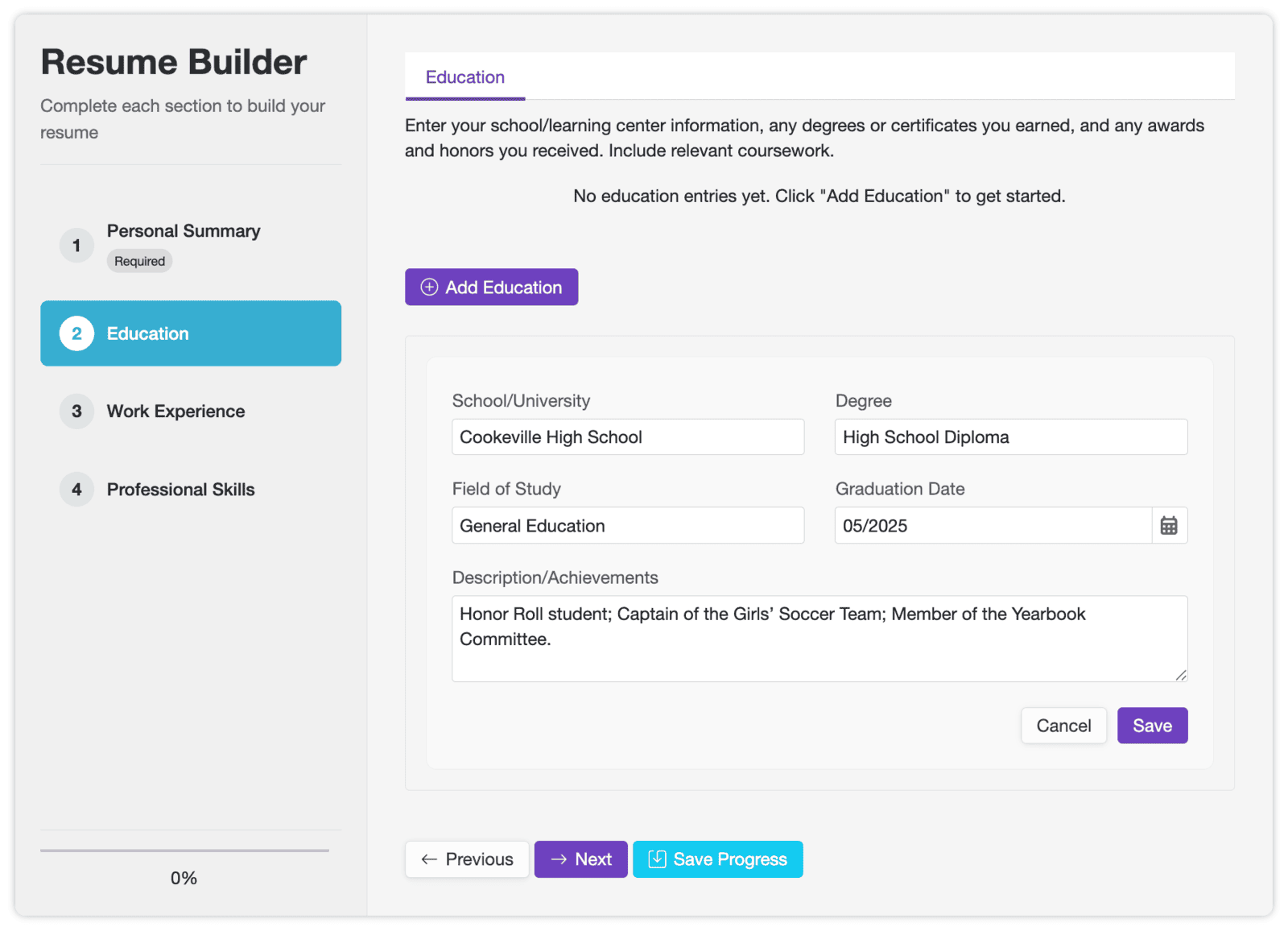
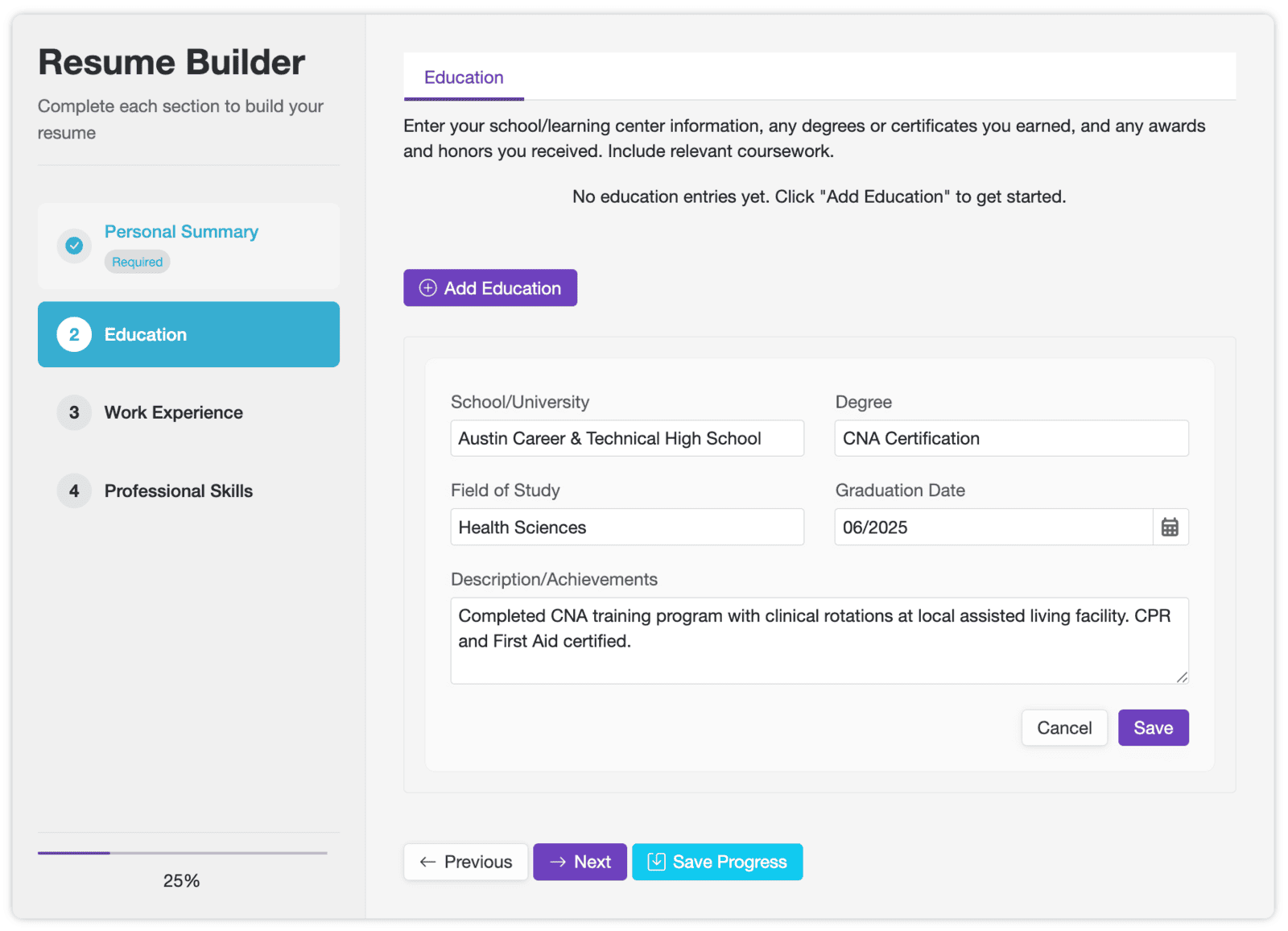
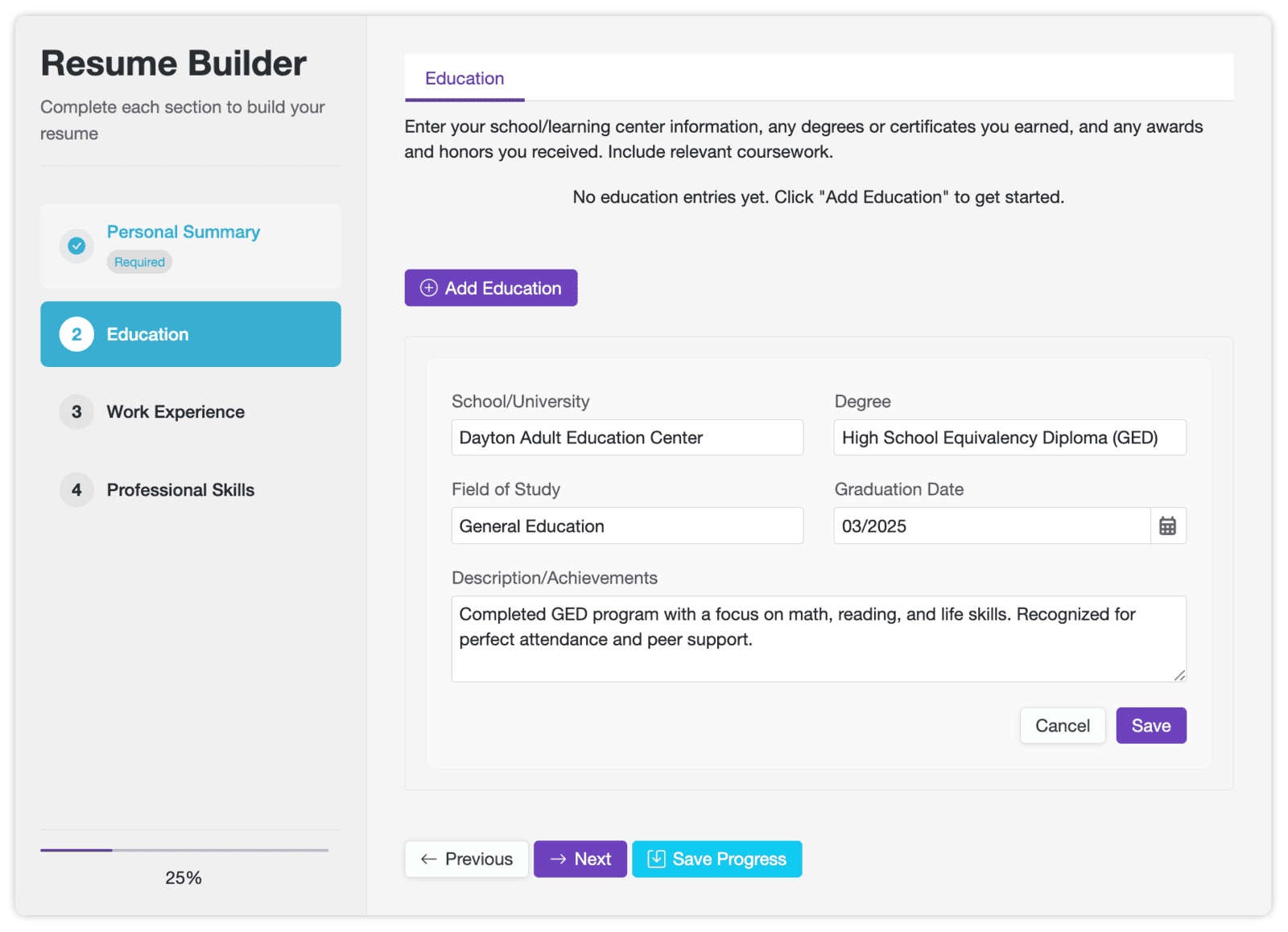
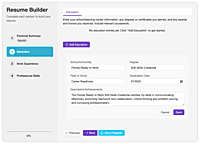
In this section, you will add your educational background. Include any degrees, licenses, or certifications earned, any awards or honors you received, and any additional courses you’ve taken. Employers are more likely to hire candidates with a growth mindset so show off your love of learning! For each entry, include:
- School/Program – This may include in-person or online programs.
- Degree/License/Certificate – Enter the type of degree, license, or certificate earned.
- Field of study – If your degree, license, or certificate specializes in a subject, enter that here. For example, Cosmetology, Nursing, or Agriculture.
- Start and end dates – Enter when you started the program and when you finished the program. If you did not complete the program, put the date you stopped.
- Description/Achievements – Briefly describe courses you’ve taken that are relevant to the job for which you're applying. You want to highlight what you learned that will help you succeed in the job. Include special projects you completed and extracurricular activities you were involved in that enhanced your educational experience. Remember to include achievements, awards, and recognitions you received in the program.
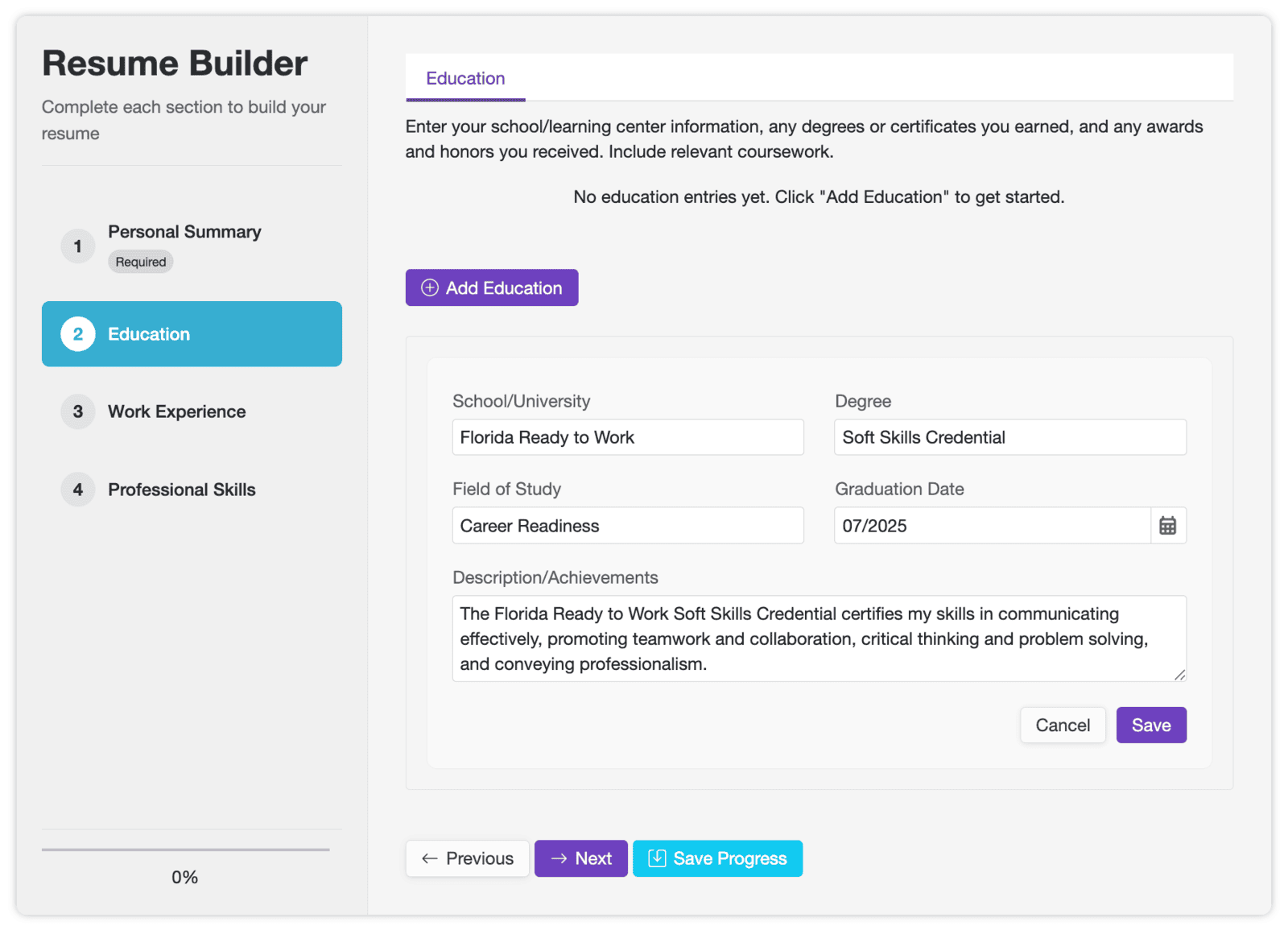
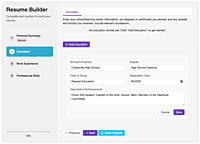
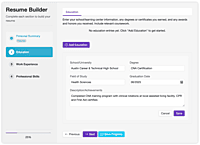
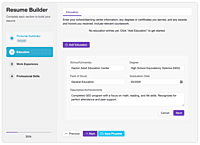
Here are some examples:
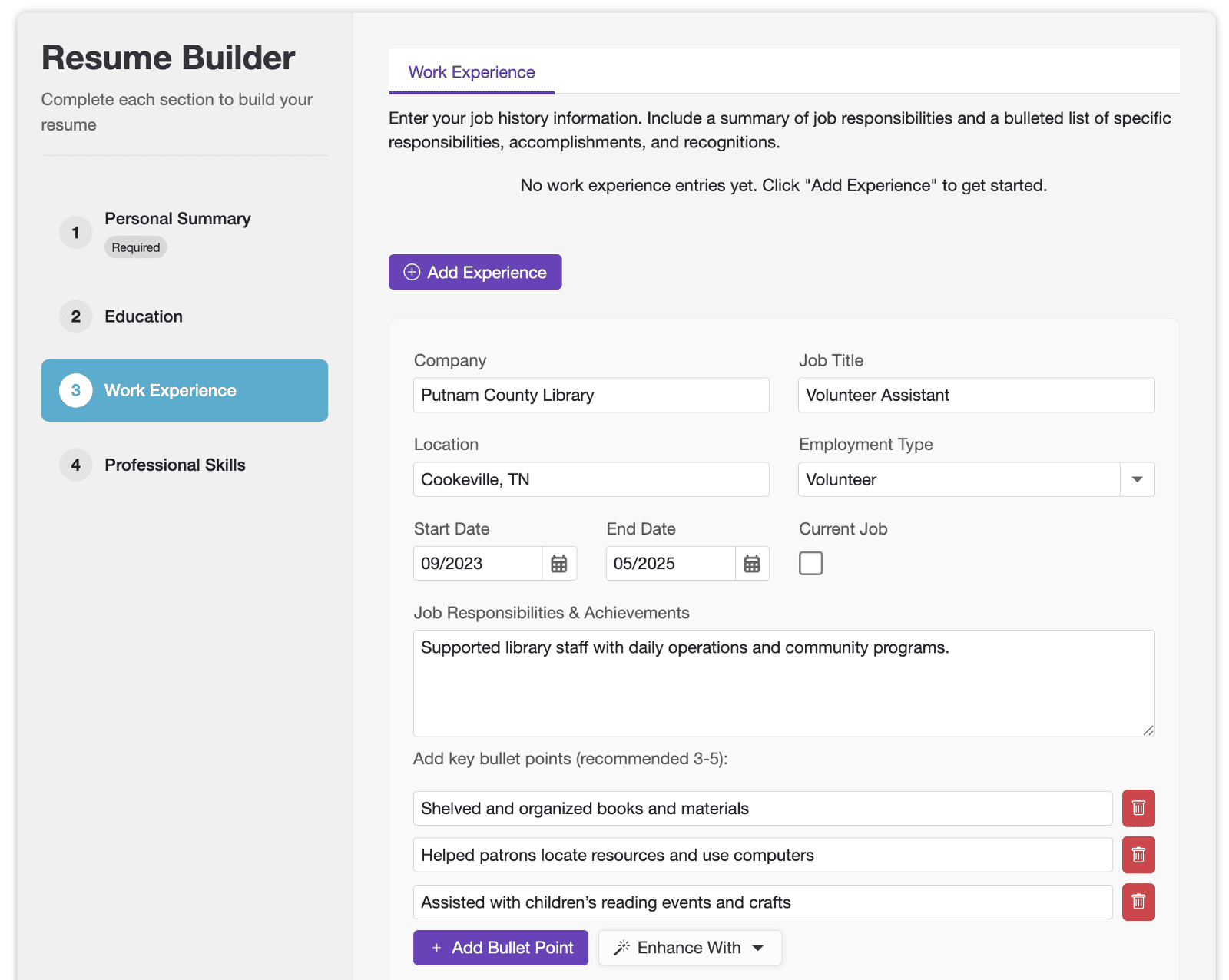
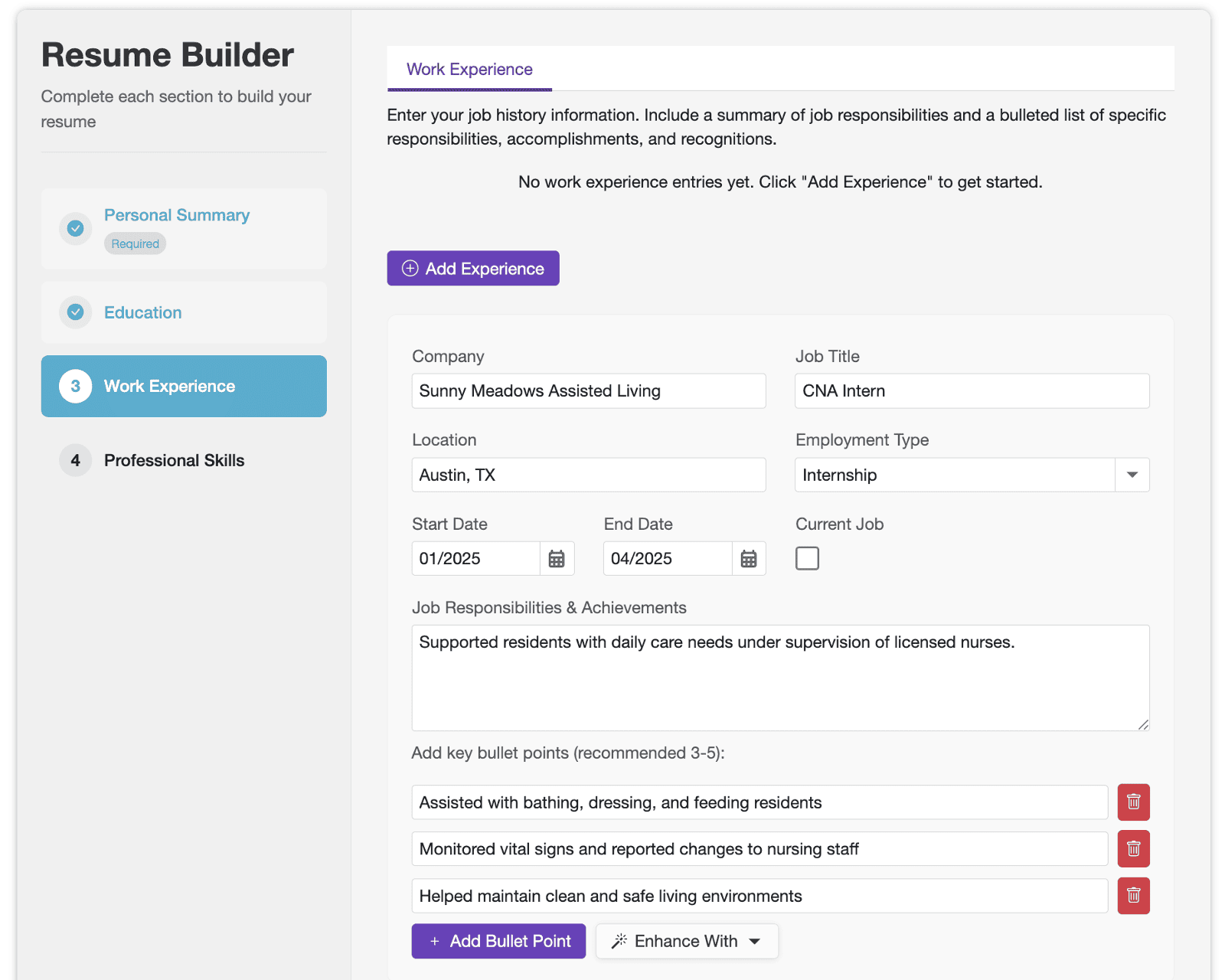
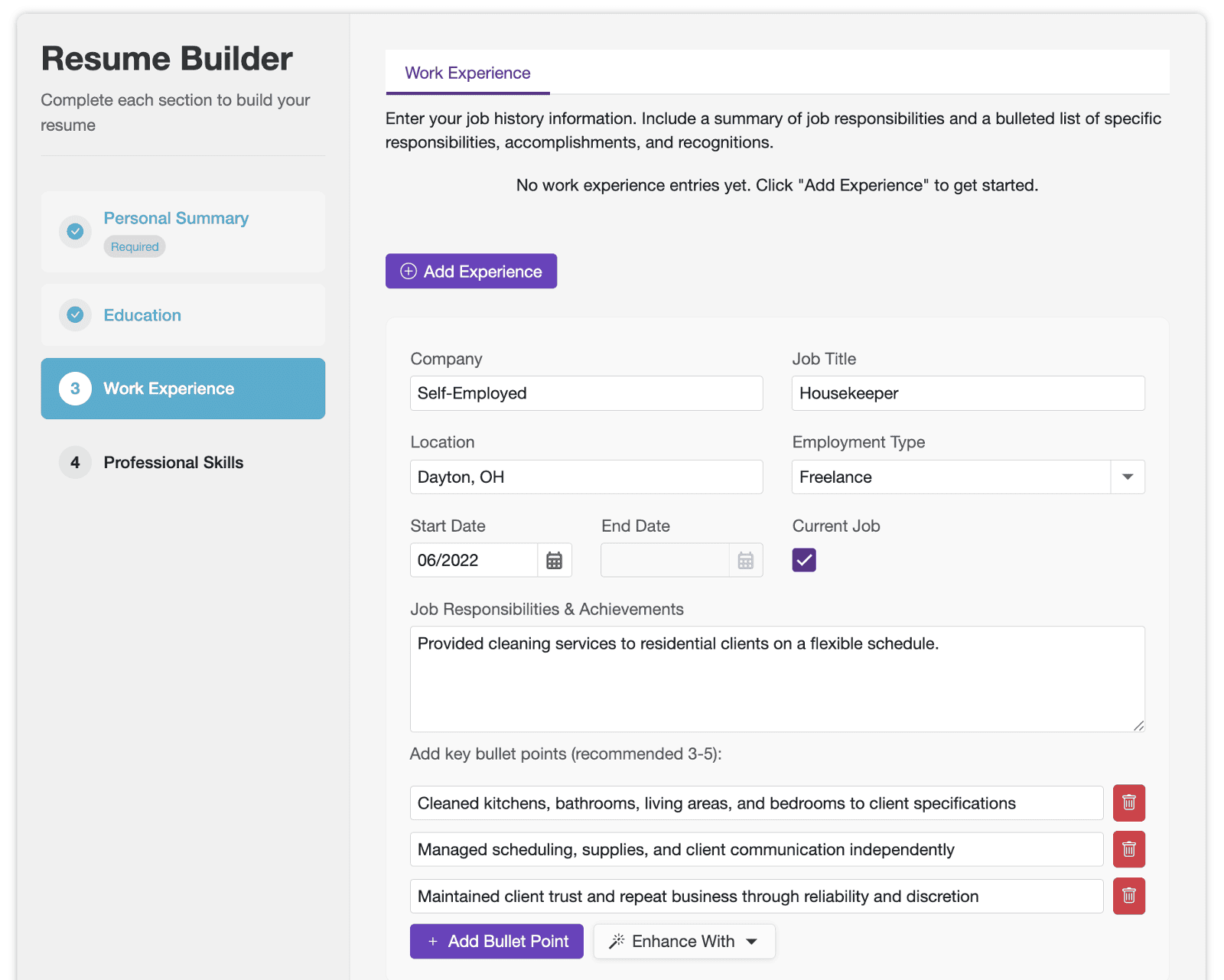
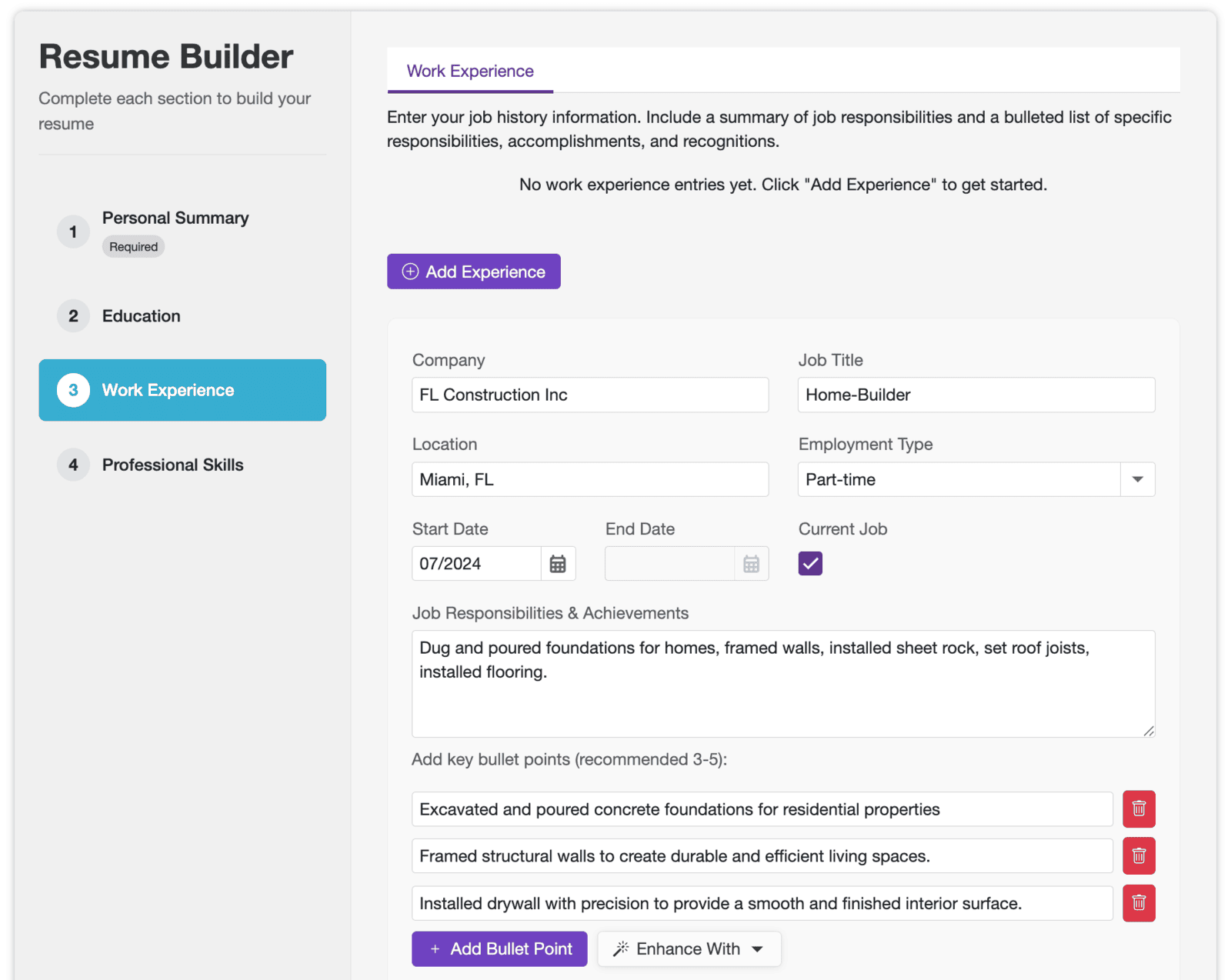
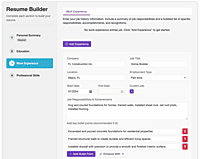
In this section of your resume, you will add your work experience. A full-time job is not the only kind of work that counts towards your experience. You can list volunteer work, part-time jobs, contract or gig work (where you are hired by a business for a few months or even a few hours to perform a certain task), or self-employment and freelance work (where you get paid by individuals in exchange for your services or products).
Include the following information for each work experience:
- Company Name – Enter the name of the organization that hired you or brought you on as a volunteer. If you have products or services you sell to individual customers who pay you, put “Self-Employed” in this field. For example, if your neighbors pay you to cut their lawns, then you would put “Self-Employed” as the company name for that work experience, but if Jones Lawncare hired you as a mower, you would put Jones Lawncare as the company name. Note that company names are proper names and should be capitalized (i.e. Jones Lawncare not jones lawncare).
- Job Title – Enter your job title or name of your role or position and capitalize the first letter of each word. Some examples are: Line Cook, Groundskeeper, Server, Driver, Nurses Aide, Surgery Technician.
- Location – List the city and state where the company is mainly located or where you did most of the work for the company. For example, if you worked for a nationwide chain restaurant, you would list the city and state of the individual restaurant where you worked, not the location for the corporate headquarters of the restaurant. On the other hand, if you worked from home for a company that is mainly located in another city, put the company location and say in the description that you worked remotely.
- Employment Type – The options for this field are full-time (regular employment for more than 30 hours per week), part-time (regular employment for less than 30 hours per week), contract (temporary or project-based employment hired by a company), internship (paid or unpaid work to learn an industry or job), freelance (project-based employment hired by customers; includes self-employment), or volunteer (unpaid work).
- Start and End Dates – Enter when you started the job and when you stopped. If you are still employed at this job, you can select the “Current Job” checkbox. If you have worked at this job off and on, just list it once and put the first start date and final end date (or select Current Job). In the description, you can describe the off and on nature of the job. For example, you might explain that it’s a seasonal job that you do every December.
- Job Responsibilities & Achievements – Enter a short description of the job you performed and any awards or achievements you received in the workplace. You can also add bullet points to showcase your specific duties and accomplishments.
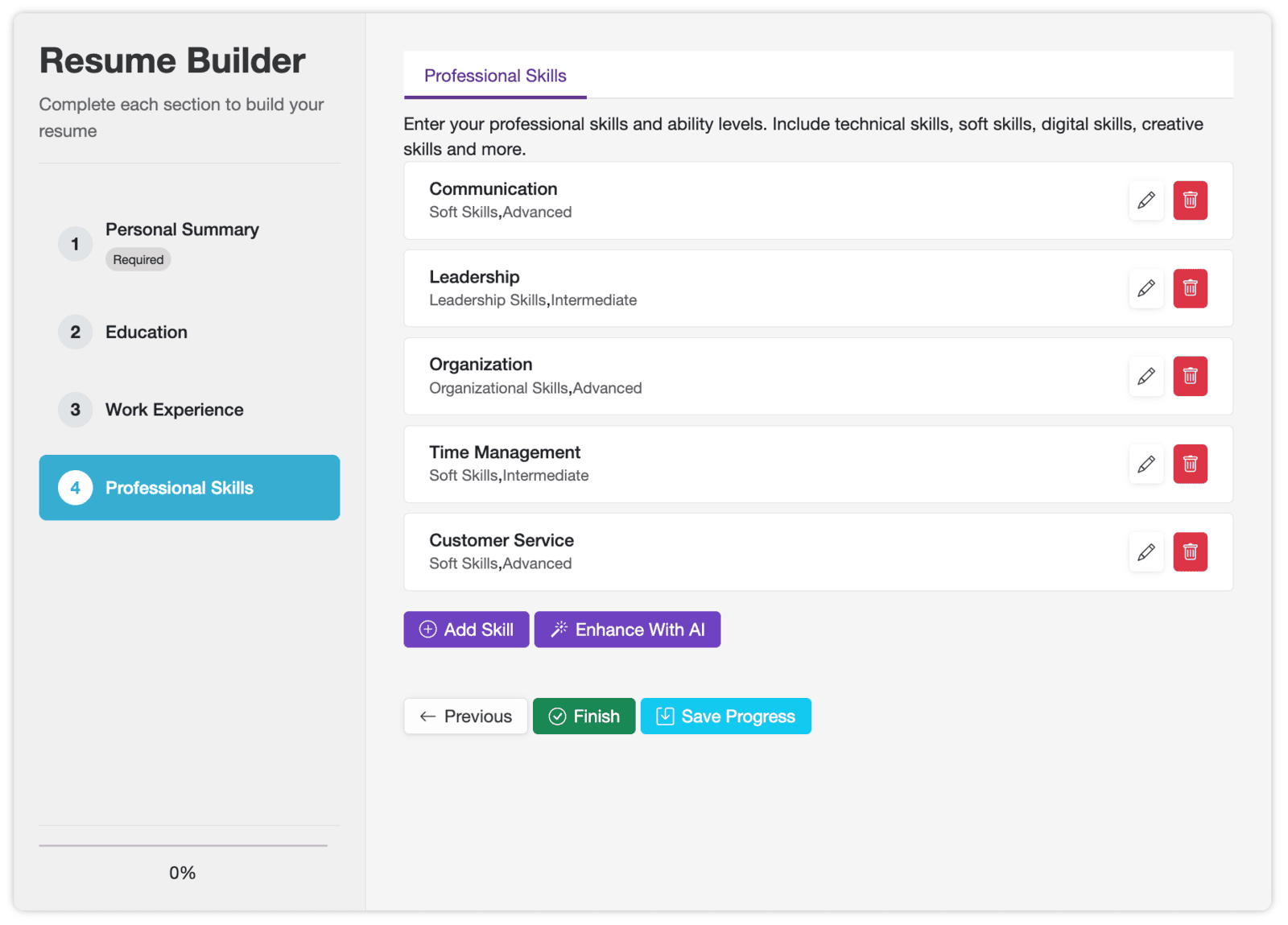
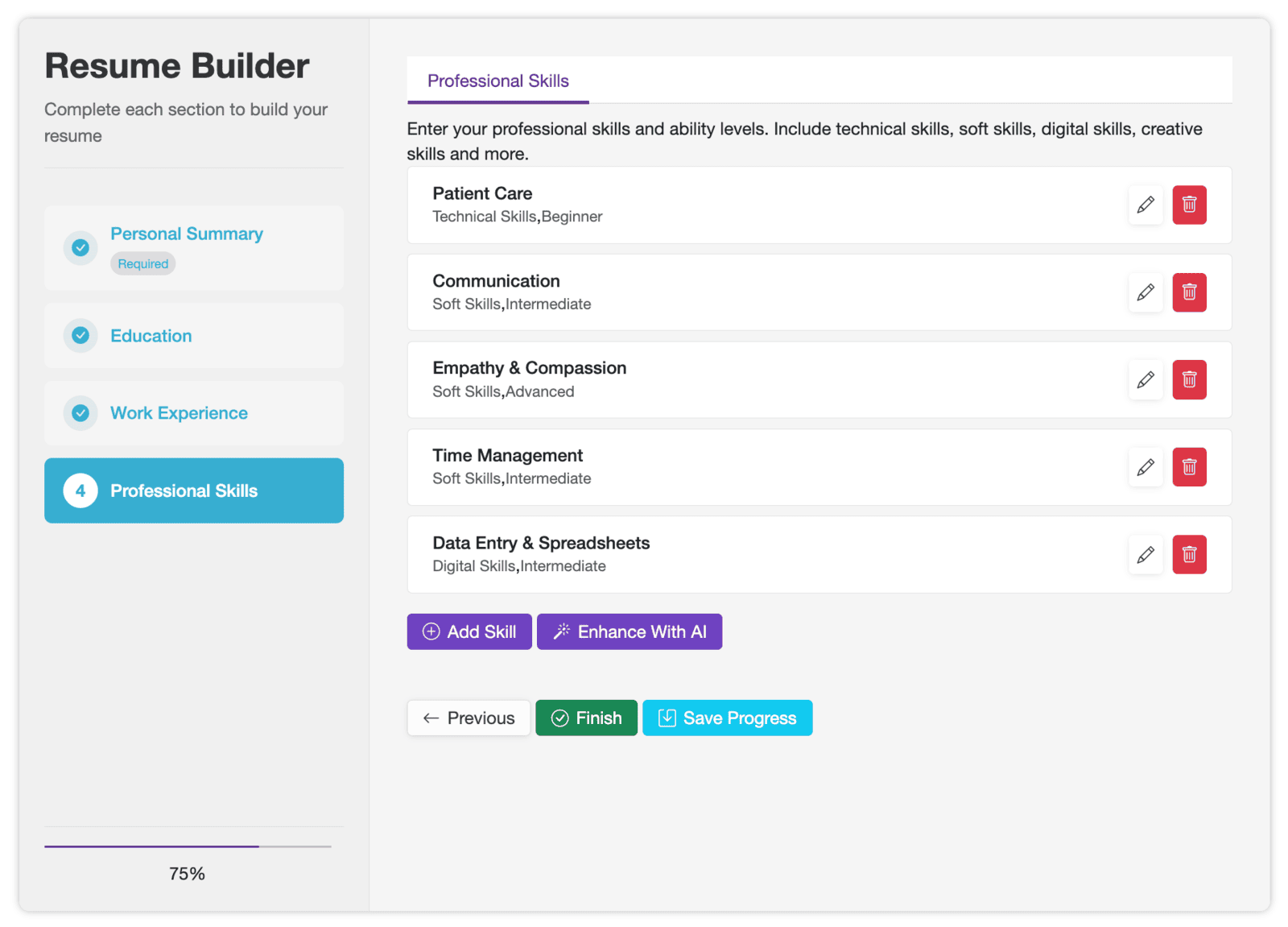
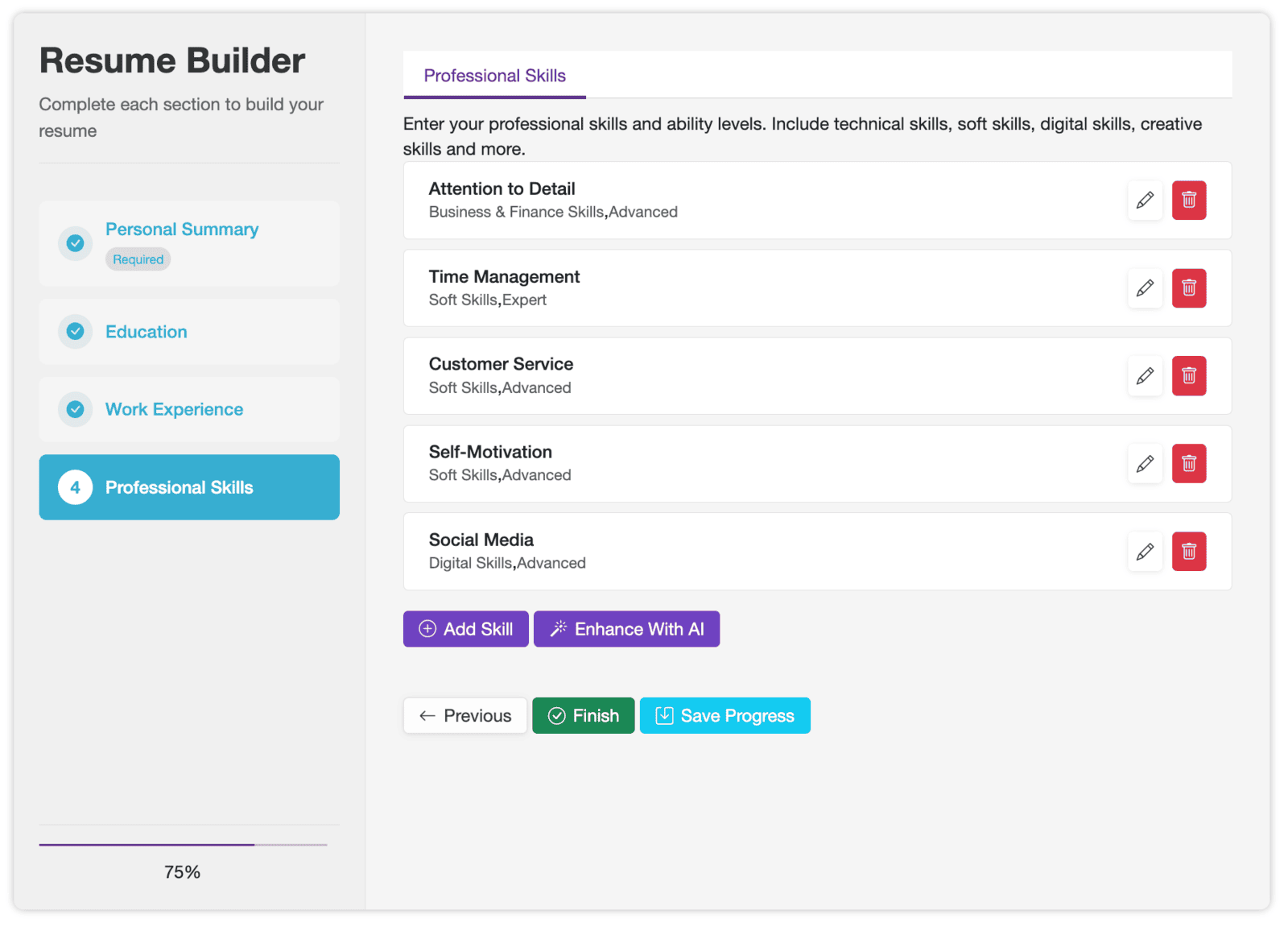
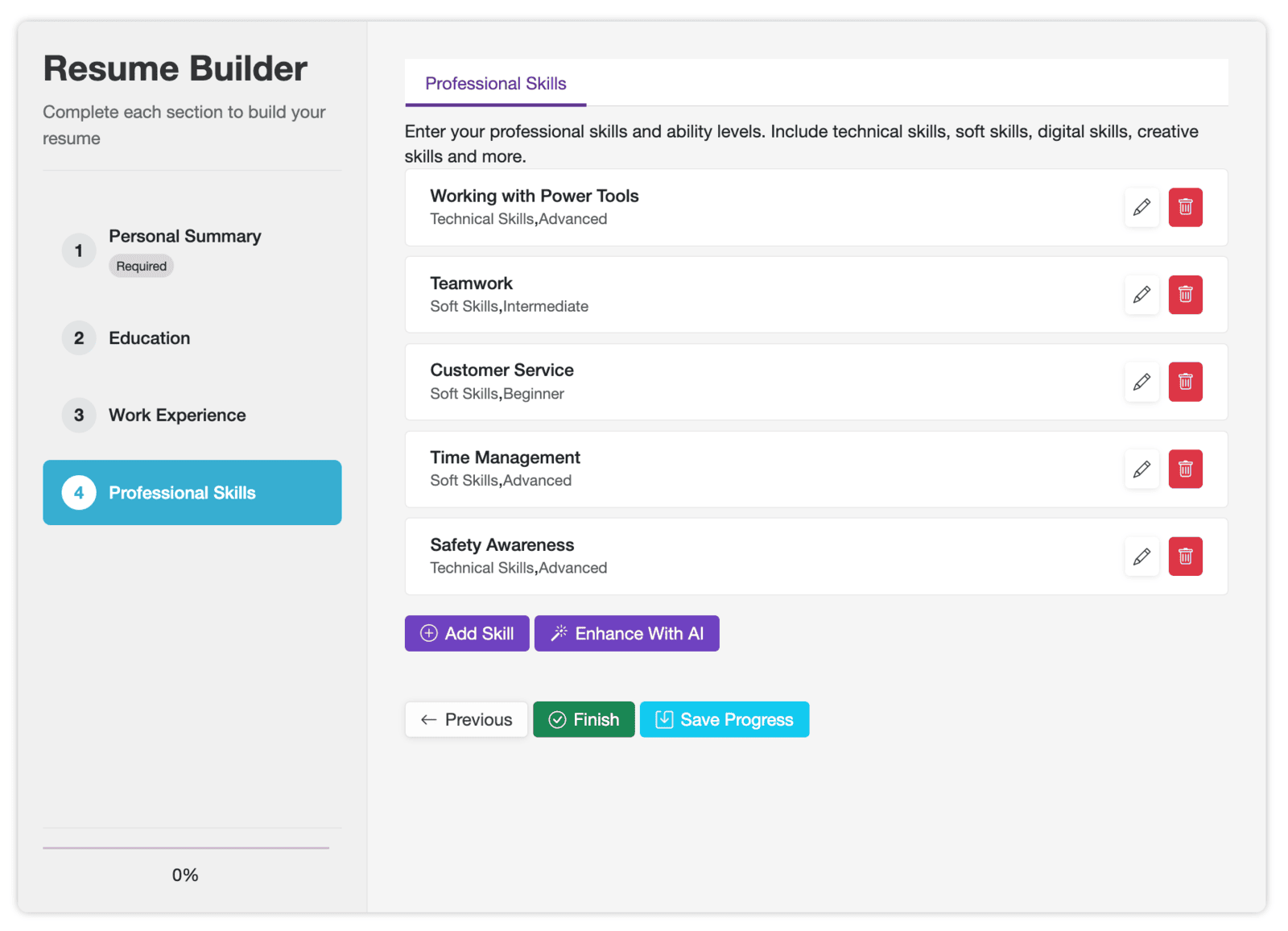
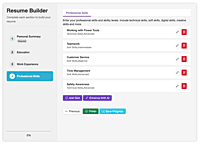
This section is an opportunity to highlight what you can bring to a potential employer, even if you haven't worked in a formal setting before. Skills are abilities you've developed that are relevant to a job, like soft skills, digital skills, or any other technical skills that could be used in the workplace.
In this part of the resume builder, you can manually add your skills by selecting Add Skill, and you can also select Enhance with AI to generate skills for you based on your professional summary in the first step. When you add or edit a skill, the tool will ask you to add how skilled you are (proficiency – beginner, intermediate, or advanced) and a skill category (i.e. soft skill, technical skill, etc.). The proficiency level will not be shown on your resume, but it will inform the Enhance with AI tool so that it can make better suggestions. The skill category is used by the tool to group similar skills together on your final resume to make it streamlined and easy to read.
Here are the skill categories and a few examples of each:
- Digital Skills – digital collaboration, Microsoft Word/Excel, video conferencing tools
- Technical Skills – operating heavy-equipment, welding, food preparation
- Analytical Skills – research, systems thinking, data analysis
- Leadership Skills – conflict resolution, mentoring, strategic decision-making
- Communication Skills – technical writing, public speaking, documenting
- Organizational Skills – inventory tracking, using calendar tools, project management
- Language Skills – translation, interpretation, bilingual reading or writing skills
- Creative & Design Skills – video editing, creative writing, painting, composing
- Business & Finance Skills – budgeting, accounting, sales, marketing
If you want to make changes, return to the steps 1-4 and edit or add any additional information. When you’re satisfied with the preview, you can download your resume and print it out or send it by email to your potential new employer. Happy job hunting!
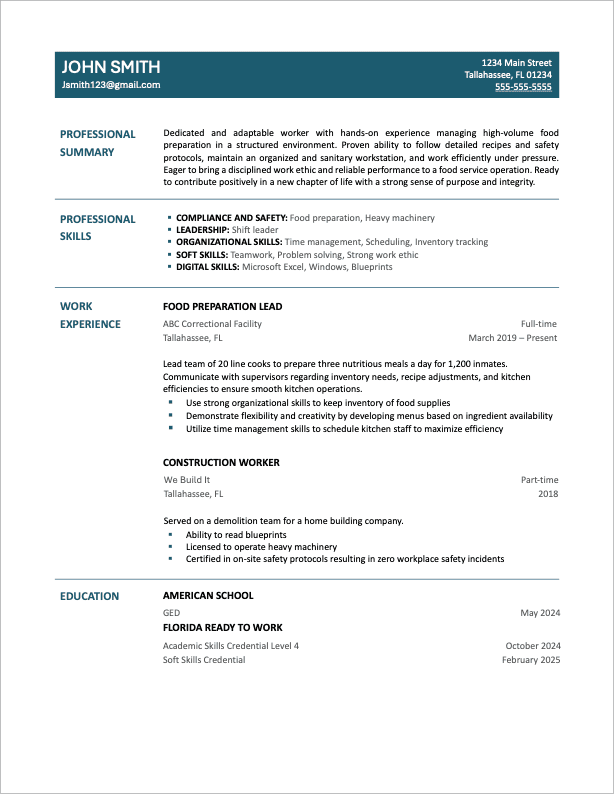
Sample Resume: